
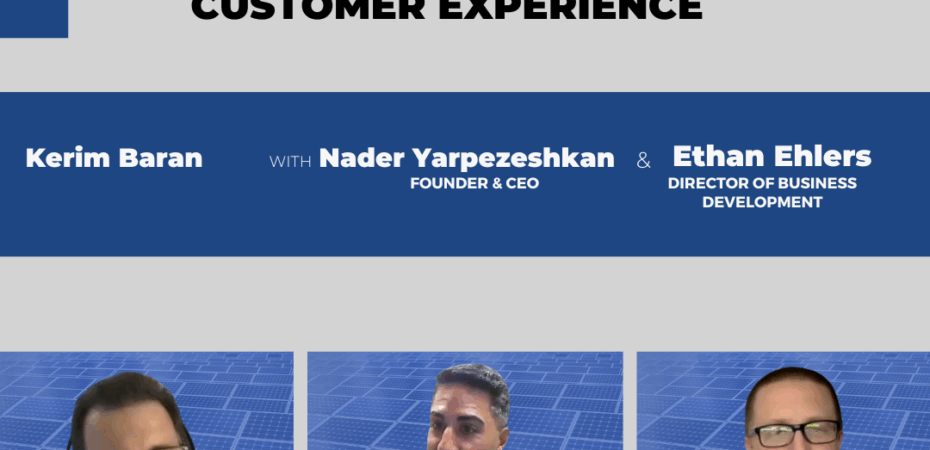
 Smarter Solar Monitoring: How NextWave is Redefining Data Transparency and Customer Experience
 In this Solar Conversation, we sit down with Nader Yarpezeshkan, Founder & CEO of NextWave Energy Monitoring, and Ethan Ehlers, Director of Business Development, to unpack how their company is transforming solar monitoring for the commercial, industrial, and community solar markets. With a strong foundation in engineering, operations, and customer-focused product development, the NextWave team is tackling longstanding frustrations with fragmented platforms, unresponsive support, and poor data visibility.
The discussion dives into the company’s origin story, the product and service philosophy behind their platform, and what lies ahead as they scale operations, integrate more systems, and lean into smarter tools.
The topics discussed included the following among others:
- Designing monitoring systems for both technical and non-technical users
- Rapid iteration based on real-world customer feedback
- US-made DAS hardware engineered for performance and reliability
- How NextWave plans to compete globally and stay customer-focused as it grows
You can find this same Solar Conversation broken into chapters and fully transcribed below.
Meet NextWave: Who They Serve and Why It Matters (2:32)
Nader’s Journey: From O&M to Founder of a Monitoring Platform (2:35)
The Big Problem in Monitoring: Poor UX, Low Visibility, and Hardware Lock-In (2:32)
Building the Team & Developing the NextWave Energy Monitoring Platform (1:12)
The NextWave Solution: Customer Centric Platform + US Made DAS Hardware (7:39)
How Being a Late Mover and Early Day Challenges Helped Make NextWave Better (4:23)
What’s Next on NextWave’s Path in Terms of Product Roadmap and Customer Segments? (7:39)
Benefits of Working with the NextWave Team (1:02)
The State of the O&M and Monitoring Business in 2025 (3:25)
NextWave’s Culture (2:14)
The Future of Monitoring and Market Impact (7:03)
The transcription of the video is below.
Meet NextWave: Who They Serve and Why It Matters
Kerim: Hi, everyone. This is Kerim, Kerim Baran with SolarAcademy. I am here today with the NextWave Energy Monitoring team, Nader Yarpezeshkan, the Founder-CEO, and Ethan Ehlers, Director of Business Development.
We are going to talk about the solar data revolution and NextWave’s quest for smarter solar monitoring. Before we go into that, Nader, you’re the founder here. I wanted to dig in a little bit into your story.
You are a Southern California guy who’s been in renewables for a long time. Tell us a little bit about how you got into renewables, your background, what you’ve done, and how that led to NextWave as a company.
Nader: Sure. Thanks, Kerim, and thanks for having us. It’s not really so much about me. I’ve been lucky, starting from the get-go of entering the solar space back in 2008 with development, with Cenergy, mainly an EPC and development firm.
Kerim: Utility-scale?
Nader: A lot of C&I at first, but now, mainly because Cenergy is still continuing, a lot of community solar and front-of-the-meter projects, but luckily, I’ve always been heading businesses with a solid team, with a foundation of engineering. At the get-go with Cenergy, that was the theme there, which was translated as time’s gone on with other companies, as well.
I did that for maybe 14,15 years. That was my first obviously, dip into the industry, but also exposure to monitoring. From there it was with PRS, Phoenix Renewable Services, focusing on infrastructure services, so O&M and asset management across, I think now, we’re in 9 States where we’ve got assets that we’re managing and delivering preventative and reactive type maintenance. But obviously there, with a whole new world of exposure, right with monitoring because that’s like the hub. Everything revolves around the performance of the asset.
With PRS again, it’s that engineering, I would say backbone.
Nader’s Journey: From O&M to Founder of a Monitoring Platform
That is the common theme though whether it was Cenergy, PRS, that’s been now going on year 10, still growing very rapidly and then now, NextWave.
Again, with the engineering backbone, and most of that’s due to my father, Hassan Yarpezeshkan. He’s an electrical engineer by trade, with a very long history of power quality, but manufacturing in the power quality space, power quality systems such as generators, backup systems, transfer switches, you name it, any big type of power components that he’s manufactured, designed.
Kerim: Just curious here. Was your father involved with Cenergy and Phoenix, as well?
Nader: Cenergy, there were three of us who founded it. He was the other piece there with Bill Pham. And then PRS, yes. While I was at Cenergy, after some time, he as usual, got the jitters to launch something else, and development was great, but obviously service has got more margin there, and we saw a major disconnect in the market. Maybe not a disconnect, but a shortfall, O&M being the last –
Kerim: Ignored.
Nader: It’s not even on the pro forma sometimes when you’re looking at the transaction. We saw that, “Okay, there’s definitely a gap there. Something that we could fill in.” I was moonlighting at the time. This is 10 years ago, when we started PRS. As time had gone on PRS got larger and more effort was needed. I slowly basically transitioned out of Cenergy. Cenergy is still doing great, led by Bill Pham there. They’re doing some big things on the community solar front across the US, actually.
With PRS, we saw this underserved vertical, and we did that with again, my father, who’s got the electrical engineering background. I’m more obviously been always on the business, the economic side with a pretty, I feel, a good handle on operations and mainly efficiency with teams, but also just execution.
I led that with PRS. And then again, maybe it’s us like gravitating towards the stepchildren of solar. So it was O&M, and then now it’s monitoring. It’s not even on the list, right?
The Big Problem in Monitoring: Poor UX, Low Visibility, and Hardware Lock-In
Kerim: It’s like they ignored part of O&M. That was the ignored part of EPC and development.
Nader: Exactly.
Kerim: And that monitoring is the ignored part of O&M. Got it.
Nader: With NextWave, I mainly lead strategy operations, but also the look and feel of the software itself. But again, I think from the get-go at Cenergy very early on, we saw that okay, monitoring is again, when it comes to efficiency, I saw it is a little bit of an area that could be improved. Whether that was lead time on getting the part, you’re trying to hit these milestones in development and EPC, whether it’s the lead time of the actual product. And then, once it’s there, you’ve got all these third parties that are ready. They want to close this transaction.
Then it’s like, “Okay, we’ve got to make sure the system’s communicating. Is it configured properly? Are we being able to get the reports that we need to?” Watching that AR, and what’s going on here? Why is it taking this long? Why is this so difficult? That was my first exposure to it, and then with PRS, like I said at the beginning performance and that data is chief when it comes to properly maintaining these sites.
We saw a lot of areas there and I think we’re lucky to understand these issues because with PRS, engineering is a big part of what we do, of course, that I keep saying the central theme, but we also have a full team of field network engineers that are in the field. They understand the hardware very well and troubleshooting and potential issues between, let’s say, the hardware and the host infrastructure system there. It gave us a leg up and understanding those issues, and then also our performance monitoring team here as well at PRS allowed us to dig deeper in understanding what areas, what functionality would improve their job? How can they report this data more clearly, a little better? How can our key accounts people at PRS deliver communication to their customers in a more effective manner?
We have this laundry list of things and then, finally, like we do most things, we’re very vertical, like Cenergy is, and like PRS.
Building the team & developing the NextWave Energy Monitoring Platform
Now, NextWave we knew we wanted to build this from scratch, the platform.
The hardware was simple but obviously, developing that software is probably the first barrier that took some time and some thinking of how we were going to approach it, us not knowing, we’re not software guys. But we’re industry. We know what it’s supposed to do. I have an idea of what we want it to look like. That just took a little bit of searching, but we got lucky with that aspect just after some different conversations. We finally hooked up with a former staff engineer who led some major development software development at big, very large companies like Qualcomm, Nokia, and you name it, other industry leaders that understood. Well, after some time, they saw what we were trying to achieve and the vision, and was fully on board, so then we we got a lot of comfort there. This is an executable plan.
Kerim: So you got your technical co-founder, essentially. When was that?
Nader: So NextWave is now six years old. That was maybe six or seven years ago.
The NextWave Solution: Customer Centric Platform + US Made DAS Hardware
Kerim: Okay. You’ve been essentially developing NextWave internally for your own needs for the first several years then?
Nader: Yeah, you’re right, Kerim.
Kerim: Is that a fair statement?
Nader: I’m glad you brought that up. Initially, with NextWave, we launched it, I shouldn’t even say launched it. We created it so that PRS can use it.
Kerim: You created an internal pilot, let’s call it.
Nader: Pretty much. With O&M, efficiency is everything, whether it’s route management, your dispatching. It’s how you’re communicating things internally, but especially the monitoring side of it.
How do we take this, absorb this part of the equation, so that we can manage it? And that’s why we launched NextWave internally so that our performance engineers and technicians can use it, and we did that for a few years and it was great.
I mean, for sites that were sensitive and we needed to get information a lot more rapidly, but also being able to make changes and not have to wait for a third party. You manage it on your own.
We did that. And then we’re always asked, “Okay, is there another party involved? Not another party, but are there other options for monitoring? Can you give us a quote on something else or can you point us to a different direction?”
I think it was just we never planned on doing this. I think it was a Friday. We were all just in a good mood and we’re having a call with a key account and we blurted it out. “Oh, have you heard of NextWave? And of course, they were like, “Who the hell is that?” That opened the Pandora’s box and we put it on a few sites for them, and they got very comfortable with it. They really liked what they saw and that just basically attached to their entire fleet.
From there we’re all busy as it is, but why not make things even more interesting? And we launched it out to market maybe about a year later.
Kerim: So the problem that NextWave is solving vis-a-vis all the other alternatives out there, how would you describe that being different than the traditional monitoring options that are out there? The fact that you’ve developed it internally. What are the extra perspectives or benefits?
Nader: For sure. That’s actually a good segue to Ethan. About a couple of years ago, when we actually came to market with it, it was mainly all organic, with no sales team, and no marketing.
Enter Ethan just this year, who’s got a lot of experience with monitoring far more than I do and putting together that value proposition and understanding the main differentiators between what’s out there. He’s entered the team as leading our sales efforts. Ethan can maybe talk to some of these points, I think. Because of his background, it can be a good point of reference.
Kerim: Ethan, you’ve been on SolarAcademy before, but let’s talk a little bit about your background and how you ended up at NextWave as well, and then dive into your monitoring background and what you saw here.
Ethan: I’ve got just about 10 years of renewable energy experience under my belt, all of which has been focused on software solutions, primarily, ranging between monitoring solutions and asset management solutions.
And something that Nader said that really resonated with me is, he and the rest of the PRS and the rest of the Cenergy team have lived through the frustrations that some of our customers experience with the other monitoring providers – lack of responsiveness, long turnaround times for quotes, for assistance, long lead times, et cetera.
When Nader and his team created NextWave, they were creating it, knowing what it was like being a customer of the other monitoring platforms out there and looking to solve specifically those problems and those challenges that they had experienced.
Not only are we industry-owned and industry-created, but we’re created by people who have been in your shoes before as a customer of a monitoring platform. I spent a number of years building up one of the other monitoring companies that’s out there. I’ve heard from a ton of different customers over the years.
One of the things that I find remarkable about NextWave, I think in particular is, I don’t get calls from my customers asking me for help getting support, getting technical assistance. People call me when they need something, when they need a new system, when they need, additional services on their software. But when they need technical support, when they need customer support, when they need operational assistance, they call their customer success rep, they call the technical support folks.
The phone gets picked up and they get the help they need. At other companies I’ve worked at, I can’t tell you how many times I, as a sales rep, get a call saying, “I need help. I can’t reach the people who are supposed to help me. I need this problem solved yesterday.” That doesn’t happen here.
Kerim: Almost like a cultural difference in customer service, it sounds like. But also, obviously, the way that customer service is designed, both in the product and in the services, I assume that is one way to describe it. Maybe, can you give some concrete examples of that?
Ethan: Of NextWave?
Kerim: Of that customer experience, a customer service issue being resolved at the first or second call with the customer service rep, as opposed to escalating to the management team.
Ethan: I mean, you’re asking me for concrete examples, Kerim, of situations that I’m not involved in because they don’t call me. They call the customer support line. The phone gets picked up. They get the help they need.
And I think you really hit on something. It’s both a structural thing. We’ve set the company up with the correct amount of support resources for our customers to use.
But it’s also a design aspect, too, where the platform is more intuitive. It’s easy to use. The information that you need is typically right at your fingertips, one or two clicks away.
It was built from the ground up by people who had experience using some of the other platforms that were out there, using platforms that were built up over time in a haphazard way with features and functionality that was buried under multiple different layers of menus, that was tucked away in a distant corner, that was thrown together haphazardly.
That’s not the NextWave way. NextWave has been planned out, thought out methodically and strategically so that when you, as an O&M professional, as an asset management professional, log into the NextWave platform, you’ll understand almost immediately how things work, where to find the information you need and how to get your job done within NextWave so that you can generate your report, analyze the performance, whatever it is you need to do within the platform, and then move on to everything else that your job entails.
It’s both a matter of having the appropriate number of resources available to help our customers at any given time, as well as designing the platform and designing the hardware so that the need for support is minimized.
How being a late mover and early day challenges helped make NextWave better
Kerim: Nader, in the early days or along the development of NextWave as a platform, what were some of these specific challenges that you’ve experienced and solved? How did you design the solutions? What were some of the impediments to growth or challenges along the way that formed NextWave to be that differentiated platform today?
Nader: I think, like I said, when it came to the hardware, that was very simple, just given the engineering background. That was very easy for us, and very early on, we had those schematics kind of drafted out. We already had an idea of which parts we wanted to use and also the reliability.
Another thing is because of PRS having an engineering and power quality side of it, we’re always called when there are these major failures. We got exposure to a lot of DAS or your data acquisition system, issues as well in the field, from weather events, whether it’s lightning or what have you.
Kerim: What were some of those major issues? Like inverter blowouts or collapse?
Nader: We’ve had issues definitely where there was, in one case, it actually wasn’t even a weather event. It was a grid issue that came back and came through the DAS and then not only fried it, but also the SELs and reclosers that were on the line as well. It had a pretty devastating impact on the rest of that loop.
Again, seeing things like this, whether it’s weather or in this case, like a grid event, we saw the need for more protections and just more robust hardware. But again, that was very natural, just given the background. The software, like Ethan already hit on, the user experience was also chief in that we wanted it to be very fluid, not having to go through so many layers.
I always like to use the salesforce example because we use it. We don’t love it, but it has a lot of functionality. We use it not to make any comparables to any monitoring companies out there, but it has all the functions there.
To get to what you want to get, and my exposure usually is to run these reports, but you go through various screens, and you’re trying to find the hyperlink to get to what, and then by that time you’re so deep underground. I’m never going to remember, despite how much Grok or AIs helped me get to that level. I’m never going to find out. I mean, a week is going to go by, and I’m not going to remember how I got to those steps.
That was huge, and again, we’re lucky, right? We’re kind of a late mover. I should say that. A lot of these companies have paved the way. They’ve done a lot of work upfront. They’ve done a lot of development over the years. And here we come and it’s like, “Oh, we used it and this is how we make it better.”
But we got exposure and we’re able to update that experience to make it a lot more fluid, more dynamic. But while allowing, you’re a very technical person to get to those views and data points that they want, but also someone that’s not technical. Like a child that gets on an iPhone, and they can quickly navigate and get to screens. We wanted that experience, as well.
And nothing against the transaction folks out there or the financiers, but they can also get in the platform and run the reports they want and get the data they want to see very quickly.
Kerim: So designing those UX layers to encompass more of the important data at that top layer.
Nader: That took a lot of time, I think. That was an initial challenge, working with again, our CTO and him seeing what we’re trying to achieve.
Kerim: You guys who interact with the customers design some of those UXs.
Nader: Definitely. We did and then explain that to the team and have them kind of understand it. I think that took obviously a lot of time, but that’s something that I think of initial hurdle.
What’s next on NextWave’s path in terms of Product Roadmap and Customer Segments?
And then the other challenge too, and this is, we try to keep this in the forefront and I’m sure Ethan is going to keep us to it, is that customer service, like the customer-centric mindset.
Because sure, we launched it and it’s moving very quickly, but we have so much more that we want to do because we just have a lot more functionality that we’re trying to achieve here, whether it’s the next couple of quarters or for the next years to come. We have a big backlog, a lot of things that’ll be launching, but we also have to basically balance that with the customer service side. Because again, one of the things that we came out of the gates was customer service.
When they do have an issue, they can call a US team, and they can walk through them through issues or virtually, however they want to handle it. But we can’t lose that. And we want to keep that on the forefront as we grow.
I think that’s going to be something that, not to say we’re going to struggle with, but we’re going to always have to keep top of mind as we grow.
Kerim: I’m assuming you have several dozen people on the NextWave side of the business and with that customer service team working hand in hand with the product development team so that the product doesn’t become that too many layered, salesforce-like experience, that’s going to be probably a key challenge as you grow.
What are some other challenges on the growth side? What do you see happening for NextWave over the next few years? How do you see demand? How do you see new markets? What major goals have you set? Tell us a little bit about that growth aspect of the business and what you are wishing to achieve.
Nader: I think as far as growth is concerned, we’re hoping because timing is key for us because we just kind of opened things up.
We want to hit the ground pretty hard and get as much attachment as possible. Again, since we have a good book right now, that’s already on the platform, in addition to a handful of very large portfolios that you would know, we have a lot of one-off, behind-the-meter type sites, but healthcare, we’ve got municipalities, federal, you name it, all the major verticals and utility-scale, as well. I feel like we’re very fortunate that as far as the customer front, the TAM is not something that it’s very large and not one that’s going to be difficult to chip into.
But that balance, I would say between customer service and new product launches is going to be something that we just have to manage. And I think we’re going to do a good job. That’s very key to me, as well as our CTO.
He’s very clear on that, as well. I think it’s just something to keep on the forefront. And then, it’s not easy right now with supply chain, I think, because we have a lot of different products, but the Made in the US, the BABA compliance stuff are things that we do adhere to.
It’s a little bit more work for our logistics, basically our supply chain team to be watching the market, knowing where things are at and making sure that whatever we’re proposing to customers today, is what we think is going to be readily available by the time the project is complete, and if not, we just have to be very quick and nimble in updating them on that. But I think the supply chain side is something that we’re also keeping on the forefront because in addition to customer service is lead time.
We have everything here is off the shelf at our California facilities, so we can get stuff out, configured. I’m talking to the site within two weeks or less even sometimes. But when our other compliance measures that they’re looking for, whether it’s ITC-related, or like I said, the Made in the US, the BABA compliance or what have you, then we just have to make sure that we have the latest and greatest from our suppliers.
Ethan: I think another big challenge we’re facing that we’re working hard to overcome is it’s just the lack of name and brand recognition. I mean, NextWave has been in business. We’ve been out there for five, six years now, and yet, when people in the industry say solar monitoring or energy monitoring options, NextWave is not the name that immediately comes to mind. There are a few out there that are very established. We want our name to be right up there with them as far as what are your options for monitoring today?
Then we also want to become known for being easy to work with, for being quick to respond, quick to help, easy to do business with, cost-competitive, while still providing an absolute leading edge market leading solution.
Hitting on Nader’s point about the hardware, all of our hardware is industry-standard hardware, but more importantly, it’s non-proprietary. It’s very easy to do business with us, but it’s equally as easy to drop NextWave and go somewhere else because nothing about our hardware solution is proprietary.
That brings it back to customer service and reiterating that it is essential for us to make sure that our customers are 100% happy, 100% of the time, because the moment they say, “I don’t like these people, I want to go somewhere else,” it’s like flipping a switch and they’re gone.
Kerim: I mean, that is actually kind of noble that you have designed your product to be open like that, to make it easy for customers to defect if they want to.
Ethan: It’s easy to come onto the platform, it’s easy to give us a try, and you should know that if you do that and you decide you don’t like this, it’s easy for you to point that data stream back to your legacy provider or whatever other new provider you decide to go elsewhere and give a try.
But we won’t let that happen because we’re here to make sure that you’re 100% happy, 100% of the time.
Benefits of working with the NextWave team
There is a lot of uncertainty in the market right now today. Nobody really knows for sure what’s going to happen with the one Big Beautiful Bill. What’s going to happen with the incentives? What’s going to happen with interest rates? What’s going to happen with tariffs? What’s going to happen with all sorts of different factors that affect our market, that we’re all playing in today?
It’s important to have a partner or partners that you can work with, where it’s easy to do business, where it’s cost-competitive and where they provide you with a quality solution that’s going to last for years and years to come. And that’s where we really come in is we are very cost- competitive compared to our competitors out there, and we’re dedicated to serving the customer. You can do business with us, knowing that that’ll save you money, while providing you with superior service and a market-leading product.
Kerim: And with a team that has been doing this for what? 17 years now, pretty much.
Ethan: And with a team that knows what it’s like to be in your shoes.
Kerim: Yeah, that makes sense.
The State of the O&M and Monitoring Business in 2025
Nader: Again, we’re lucky, and maybe that was by design. The PRS, whether it’s O&M or in this case monitoring, it’s a pretty de-risked play I feel in solar, if you were to choose other industries within the company, whether it’s racking manufacturer, inverter manufacturer, like those guys.
Kerim: Or an EPC play or a resi installer. All the resi stocks as of – today is June 18th. I think yesterday, they all went down between 25% to 40% in the stock market.
Nader: It’s crazy. I don’t know how they go to sleep, and when I was at Cenergy, at one point there was, what was it? I think, that the first feeling of “Oh, my gosh. Oh, the CSI program” when you had those steps. Do you remember? What was it? The performance-based incentive? The PBI.
And it had these steps like it’d start off at, and I don’t remember which direction. I feel like it was like Step 10 was a couple of dollars a kilowatt hour. I don’t remember but it was really rich.
As time went on, depending on the IOU, you had a certain amount of right budget. I remember watching the ticker on that thing, and it was like, I have anxiety every time. “Oh, am I going to get this customer in at this level? Is it that level? What type of conversation am I gonna have with them?”
Then you took an ITC. “Okay, what policy are going to do with this administration or the tariffs?” Then these changes, and then community solar, and how certain States were going through voting, and what level is it at development?
I mean, I’m only 41, and you could see the gray hair. This is all development. Honestly, I swear. Luckily with O&M again, I think you’ve got a very large –
Kerim: Much more stable business.
Nader: Right. You do and it’s service-based, and that TAM is constantly compounding every quarter, and I think that’s the same with monitoring. We’re lucky there. Not so much we have to do, but I think the industry as a whole, you’re constantly, I feel sure you’re focusing on top line. But really, a strong C-suite is really looking on how to increase risk-adjusted value. How can you do that? I think with every company, that’s different.
Kerim: Are you guys hiring right now, despite all this uncertainty in the market?
Ethan: Well, I’m hiring account executives within my team. But I think you had some folks in for interviews just last week, I think, Nader.
Kerim: You’re definitely a growing business, despite all this uncertainty.
Ethan: We’re growing. We’re privately owned. We’re bootstrapped, and we’re profitable.
I think, it’s also important to consider as well as when you do business with NextWave, you’re doing business with a partner that’s here for the long run. We’re not VC-funded.
Our continued existence isn’t contingent upon hitting KPIs this year. We aren’t burdened with tremendous amounts of debt. We aren’t beholden to public shareholders demanding that we maximize their value over the course of the next 18 months. Our sole focus is making our customers happy and continuing to do so profitably.
Nader: We are hiring. I think I feel like we’ve been constantly hiring, and hopefully, I think you were talking of the challenges earlier.
NextWave’s Culture
The culture too, what we’ve created here, both at PRS, I feel, and at NextWave, is one that’s focused on over communication.
What that does is it fosters a sense of inclusion, trust, and empowerment. In that way, the employees feel valued, right? They’re heard and they’re confident in their roles.
Then also because that information is very freely moving across departments, I think it forces the team to the line with, the customer first quality or the customer first driven type of mindset.
I think that really helped propel the growth. Sure, we have ads, whether they’re on Indeed or LinkedIn or etc, right? But we’ve been lucky in that we’re getting a lot of looks through word of mouth. They are hearing what we’re doing. They’re saying, “Oh, shoot. These guys are serious.” And with one of our major visions is bringing monitoring to the spotlight.
It’s been, again, like in the shadows, one of the stepchildren of solar, in addition to O&M. We want to bring it to the forefront. We’re bringing attention to it that it is important, and there are different levels of quality that can be seen depending on what product you’re looking at, but also customer service, like we talked about, but what the platform is meant to do.
A lot of those issues that we’re hearing at these asset management conferences or the big industry-level ones like RE+, is about, “Oh, you’ve got aging infrastructure and there are these issues now. How can we improve O&M and how can we improve the top line?”
All these really are circling around the data, right? Everyone talks about data and the importance of it. So it is the monitoring. That’s the crucial aspect here. So we really want to bring that up to the forefront and hold those companies, including us, accountable for that because that is, again, the main communication driver, which goes hand in hand with our vision.
The Future of Monitoring and Market Impact
Kerim: I got a curious question on that. Are there reports or publishings that average out the industry data and put it out in some sort of a statistical analysis for asset management and O&M? Is there an industry-wide effort that does that? I think it would be a really cool project if you guys led something like that.
Nader: Totally. No, they talk about it.
Kerim: Everyone talks about it, no one does.
Nader: No, Kerim, no, really. No, they do bring it up. “Oh, we should do this right across even our competitors in different industries within solar. We should share this data.” That is the way to do it, right? Yeah, definitely.
Kerim: You guys probably have plenty of data. If you could anonymize it and publish it somehow, it would be insightful for analysts, purchasers, for just general industry people to see it.
We’ve all been in solar for plenty of time now, but in the early days, everybody used to say, “Oh, solar is hogwash, it’s not real, it will never be anything.”
Now, we’re like 5% of all electricity and we will soon be 50%. What most people don’t realize because industry is growing 30% on average for the last 30 years and everybody seems to forget that.
So sharing the specifics about what those expected production forecasts are and by how much people are missing it or overproducing because that’s the next level of scare tactic that someone could use for solar. It never produces what it promised. Okay, is it missing it by 20% or by 2%? Of course, all of that stuff is relevant when you’re managing an asset and having that data public would be great.
Nader: You’re starting to slowly get into our pending AI patent, but definitely, yeah. We’re thinking that all that is very important, but it’s just a matter of how you’re categorizing the data, how you’re collecting it and compartmentalizing it rather. Then totally it will be very valuable. I think everyone is going in that direction, hopefully.
As we all do that, then hopefully at that point, then maybe that data could be shared and the industry can look at it. Because there are so many variables depending on environment, design, and preventive maintenance measures on these assets over the years. What have they been doing? There are so many pieces to it. It’s really hard to give those meaningful data points without knowing all the history.
Ethan: I chuckle a little bit, Kerim, because I’ve heard this sentiment for years and years and years. I’ve heard it from so many different companies.
Wouldn’t it be great if we could have this giant pool of data that we could all draw from and be able to do deeper analysis and get greater insight into blah, blah, blah, blah, blah?
But the moment you talk to any individual company and say, “Would you be willing to participate?” it’s “Oh, well, our data is proprietary. And it’s what gives us an advantage in the market and we just really can’t share that at this time.”
We as a monitoring provider, we have to be careful too because we don’t actually own our customers’ data. Our customers own their data. We’re simply stewards of their data, housing it on their behalf, and providing them with easy access to analytical tools to do what they need to do to analyze that data.
So yes, it would be great if – but the way that these businesses are structured and the way that our business is structured doesn’t allow that to easily happen.
Kerim: Right, right.
Ethan: Hopefully, someday we can get there, but right now, there are significant barriers to making that happen.
Kerim: It’s a good analogy to a situation I remember from having been in solar equipment distribution and related distribution markets.
I know in the electrical market and even in publishing, I think there’s an app, there are opt-in data dumps you can do to certain platforms and you get the industry-wide statistical analysis back having inputted something. Sometimes it’s for free, sometimes it’s for a fee, but you’ve got to contribute to data to get the data back. Well, I think it’s a matter of maturization.
Nader: Yeah, definitely. I think so, too. There’s just so much and I get it, right? There’s so much going on across the entire industry. It’s hard to come back to these things, but I think you said as things mature and hopefully maybe settle a bit because there is right now a huge focus on that data because now it’s so powerful, with what you can do with it, given the technology. I think it’s going to get there for sure. It’s just a matter of time.
Kerim: I mean, it’s a very important asset class, obviously, just like real estate is a very important asset class and on real estate management companies, it’s a whole industry.
These are a real asset also, in managing and maintaining these assets is not effortless. There’s obviously a lot to be done, and you guys are at the forefront of that.
Nader: We’re excited. No, it’s definitely very exciting times. I think this is something and NextWave is something we’ve always thought about again, since plus 17 years ago, but it’s great to see it coming to the forefront now with monitoring in general, but now with NextWave. We’re really excited about the opportunity.
I think in the coming years, you’ll see things shape up, and we’re hoping just to deliver a very strong platform with reliable hardware and just make sure we’re getting all the data points out to customers and solving issues that people are seeing out in the field.
Kerim: Great. Ethan, Nader, thank you so much for sharing this story and giving us an insight into really a 17-year-old team that has pretty much walked every path in the solar industry, that has seen the problems firsthand, from customer perspective and created solutions, not only in the O&M services, but also in energy monitoring platforms as a data platform, solving these major challenges as the industry grows and assets need to be maintained. Thank you for this great conversation.
Nader: Thanks, Kerim.
Ethan: Yes. Thank you, Kerim. It’s always a pleasure talking with you and appreciate you giving us the time and your platform.
Kerim: Yeah, and more soon. Thank you.