
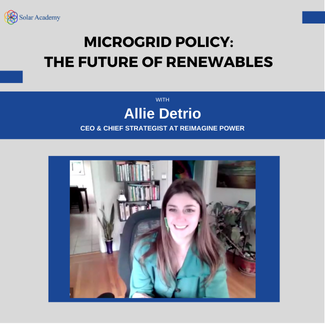
In this Solar Conversation, Kerim Baran speaks with Allie Detrio, CEO and Chief Strategist at Reimagine Power, about why smart policy is the missing piece to unlock the full potential of microgrids. Allie breaks down how multifamily solar and storage can serve as the building block for community-scale microgrids, what went wrong and right in California’s microgrid commercialization efforts, and how Oregon’s new resilience and microgrid services framework offers a replicable model for states looking to modernize their grids and empower local communities.
Chapter summaries of this conversation are below:
- Solar, Local Power & Allie’s Path into Energy (00:00)
Kerim opens with Elon Musk’s view that most future energy will be local, distributed, and solar. Allie agrees, citing a famous Edison quote about “betting on the sun,” and shares how she went from a weed-out engineering student at ASU into sustainability, energy policy, and eventually running her own consulting firm, Reimagine Power. - Multifamily Solar as a Microgrid Building Block (03:03)
Kerim notes Allie’s work with Ivy Energy on multifamily solar in California. Allie explains that multifamily buildings are a key “starter level” for community energy: one property, many tenants, shared solar and storage, and solving the split-incentive problem between renters and landlords. She sees multifamily projects as the foundation for larger campus, multi-property, and neighborhood microgrids. - California’s Microgrid Push: Progress and Frustration (04:30)
Allie talks about working with Senator Stern on SB 1339, California’s 2018 microgrid commercialization bill, and then fighting through multiple CPUC rulemaking tracks. While California has seen progress in single-customer microgrids and some multifamily solar+storage, she says the framework remained utility-centric, focused on investor-owned utilities (IOUs) and a 20th-century, centralized grid model. Regulatory language and concessions in the bill allowed the CPUC to limit third-party, multi-customer microgrids far below what she and the Senator originally envisioned. - Why Oregon Studied California’s Mistakes (09:26)
Oregon faces many of the same challenges as California, wildfires, remote rural communities, urban/rural divide, and rising energy costs as the grid ages. Allie explains that Oregon looked at California and asked: what worked, and what got in the way of microgrid growth? They saw that old laws, utility-centric rules, and cautious regulators were stalling California’s full microgrid potential, especially for community and multi-customer projects. - Oregon’s Different Utility & Political Landscape (10:23)
Unlike California’s “big three” IOU-dominated system, Oregon has more community-owned utilities and co-ops, plus smaller IOUs that are less politically entrenched. Its legislature is part-time, with lawmakers who hold other jobs and were surprisingly open, candid, and policy-focused when Allie met them. She contrasts this with California’s full-time, DC-style politics, saying Oregon lawmakers were more interested in practical solutions, compromise, and true public service. - Community Energy Resilience as the On-Ramp (12:30)
Allie and her coalition brought to Oregon a “community energy resilience” framework first floated in California: give local communities funding and capacity to plan for outages, natural disasters, and resilience. Once communities think seriously about resilience, the obvious technical answer becomes microgrids and distributed energy resources. This framework led to Oregon’s County Energy Resilience Program, an initial grant program that funds local planning and pilot projects. - Monetization Pathway vs. Just Subsidies (15:09)
Allie explains the key idea of a “monetization pathway” for microgrids: instead of relying only on grants or tax credits, microgrids should be paid for the services they provide to the grid (capacity, grid support, reliability, etc.). That turns microgrids into revenue-earning grid assets, not just subsidized feel-good projects. She argues California’s programs are still too patchy and complex, while Oregon is moving toward a more coherent microgrid services tariff to enable true commercialization. - Over-the-Fence Rules & Multi-Customer Microgrids (16:20)
Kerim brings up the “over-the-fence” rule in California, which blocks someone from selling electricity to neighbors without becoming a regulated utility. Allie says almost every state has some version of this, and it’s a major barrier to community microgrids. Oregon’s new framework includes ideas like microgrid geographic zones and third-party interconnection to let communities legally share power across properties, while still respecting public-utility definitions and oversight. - How Oregon Passed Strong, Bipartisan Microgrid Bills (21:30)
In 2024, after earlier attempts and a legislative walkout in 2023, Oregon passed two major microgrid bills with the entire House Energy & Environment Committee signed on. The laws create a statewide regulatory framework for microgrids (including third-party development and ownership) and direct the Oregon PUC to open proceedings on tariffs and compensation. Allie emphasizes that, unlike California, they didn’t have to swallow “poison pills” or water down the bills; broad support from counties, cities, munis, co-ops, and both parties helped the bills sail through. - Exporting the Oregon Model to Other States (24:30)
After presenting Oregon’s story at a microgrid forum in Austin, Allie was immediately approached by people asking how to replicate it in Washington and elsewhere. She now sees interest from states like Washington, Colorado, Ohio, Michigan, and others that might not be seen as “clean energy leaders” but are pushing innovative local policies. She expects Oregon’s success to become a template for other states looking to modernize their grid and enable community-scale microgrids faster. - High-Cost vs Low-Cost States & Who Builds Microgrids (27:42)
Kerim asks whether lower-cost regions like the Southeast or Texas can “skip ahead” directly to microgrids. Allie says in high-cost states like California, customer and third-party microgrids are driven by rate pressure and long-term cost certainty. In many Southeastern states, vertically integrated utilities control generation and wires and often have first right of refusal on new generation, so microgrids there are typically utility-owned pilots or “non-wires alternatives.” Lower rates and conservative, risk-averse munis/co-ops have slowed adoption, but falling technology costs and rising resilience needs are starting to change the equation. - Munis, Co-ops, IOUs & the Future Utility Model (33:37)
Allie explains that munis and co-ops don’t have shareholders, are locally governed, and aren’t regulated by state PUCs the same way IOUs are, which makes decisions quicker if you can show a clear local benefit. IOUs everywhere can build microgrids, but there are fairness questions if they “rate-base” special microgrids for a subset of customers. She thinks the big tension now is between the old 20th-century model (centralized, asset-heavy grids with guaranteed returns) and 21st-century needs (resilience, decarbonization, customer empowerment), and that business models and incentives will have to shift so everyone can still “eat from the pie” while making room for distributed solutions. - Allie’s Vision: Break the Fences, Scale Microgrids Everywhere (37:50)
Today, Allie is working on new-home communities and regulatory implementation in California, Oregon, Colorado, Washington, and watching the Midwest and Texas closely. Her top “big swing” is to finally break California’s over-the-fence rule; she believes if they can reform it there, it can be done anywhere, unlocking massive growth of campus, multifamily, and neighborhood-scale microgrids. She closes by noting that microgrids are largely nonpartisan, they can use diesel, gas, bioenergy, or solar+storage, and that growing demand for resilience, cost certainty, and decarbonization will keep pushing microgrid adoption across the country.
About the Guest
Allie Detrio is the founder of Reimagine Power, a San Francisco–based policy and regulatory consulting firm focused on microgrids, distributed energy resources, and advanced clean energy. With over six years running her own firm and prior experience across multiple energy roles, she advises companies, coalitions, and governments on how to modernize utility rules, design microgrid-friendly tariffs, and scale community-focused clean energy solutions, especially in Western states like California and Oregon.