
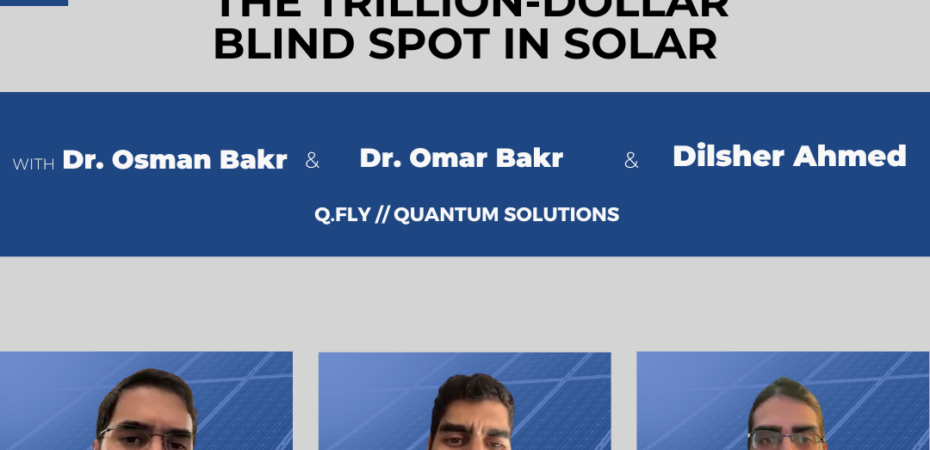
In this Solar Conversation, Kerim Baran sits down with Dr. Osman Bakr, Dr. Omar Bakr, and Dilsher Ahmed of Q.Fly to explore a fundamental blind spot in the solar industry: the inability to see what’s happening inside solar panels. While solar has become a trillion-dollar global asset class, most inspection methods today still rely on visual and thermal techniques that miss early-stage defects such as micro-cracks. The conversation introduces a new approach rooted in physics — using shortwave infrared (SWIR) imaging to detect hidden structural issues long before they manifest as visible or thermal anomalies. As Osman explains, this “invisible light” spectrum reveals material-level changes that precede failure, effectively allowing operators to see problems before they become costly.
The discussion then moves from science to real-world impact. Omar and Dilsher outline how this technology translates into scalable asset intelligence for solar operators, insurers, and asset managers. From reducing massive O&M inefficiencies to enabling better warranty claims and insurance underwriting, the team frames Q.Fly as a “truth layer” for solar infrastructure. With trillions of dollars in solar assets and even small performance gains translating into significant economic value, the conversation highlights how better visibility — powered by physics, AI, and automation — could fundamentally reshape how solar assets are managed over the coming decade.
Chapter summaries of this conversation are below:
1. Opening: The Trillion-Dollar Blind Spot (00:00)
Kerim frames the core problem: solar is a trillion-dollar asset class, yet current inspection methods miss most internal panel damage, setting up the need for a new approach.
2. The Science of Invisible Light (SWIR) (07:48)
Osman introduces shortwave infrared and explains how this invisible spectrum reveals material-level defects that cannot be seen with human vision or traditional tools.
3. Why Traditional Inspection Falls Short (12:04)
Discussion of limitations in visual and thermal inspections, including inability to detect internal damage and lack of per-panel measurement in large systems.
4. Scale Problem: Millions of Panels, No Visibility (15:06)
The conversation shifts to the operational reality of utility-scale solar — millions of panels and no efficient way to diagnose individual panel health at scale.
5. Hidden Damage from Installation & Early Lifecycle (22:32)
Osman explains how damage often occurs during installation and early operation (e.g., walking on panels), remaining invisible for years, and introduces the idea of a “birth certificate” for panels.
6. The Q.Fly Solution: Physics + AI (25:03)
Introduction of Q.Fly’s core concept — combining advanced sensing with AI to detect, classify, and quantify panel defects.
7. AI, Scale & Cost Reduction (27:28)
Dilsher explains how AI enables scalable interpretation of imaging data, replacing costly manual inspection and enabling defect classification and power-loss correlation.
8. Economics & Customer Value (31:05)
Discussion of cost savings, ROI, and how the solution anchors value around operational efficiency and improved asset performance.
9. Insurance, Warranty & the Need for Truth Data (42:14)
Deep dive into insurance dynamics — renewable assets are difficult to underwrite without accurate condition data, positioning Q.Fly as a critical data layer.
10. Future Vision: Autonomous Solar Asset Management (49:56)
Closing discussion on the long-term vision: fully automated, closed-loop solar systems with drones, sensors, and AI continuously monitoring and optimizing performance.