


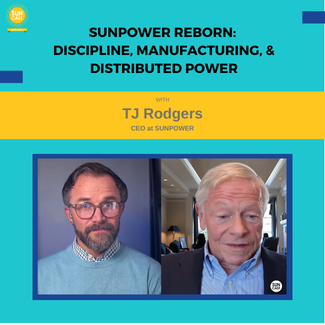
In this unfiltered, deep dive conversation, Nico Johnson of SunCast and SolarAcademy interviews Silicon Valley legend T.J. Rodgers. Rodgers recounts his journey from a $750K personal bet on an early-stage solar startup to building (and rebuilding) a $10.4 billion solar powerhouse. Beyond solar, Rodgers also holds a remarkable distinction: he is the longest-serving founder-CEO of any public company in history, having led Cypress Semiconductor for over three decades — a tenure that shaped one of Silicon Valley’s most disciplined chip companies.
This conversation isn’t just a historical tale of one of the oldest and best-known American solar companies — it’s a masterclass in technical leadership, capital discipline, and the often misunderstood mechanics that separate companies that endure from those that collapse under hype. Whether you’re a founder, investor, or operator in the energy transition, this episode delivers rare perspective on what it actually takes to build durable technology businesses in solar — and to rebuild them when they falter.
Not many people in the modern solar industry truly know T.J. Rodgers. Most recognize Dick Swanson as the founder of SunPower (NASDAQ: SPWR) — and rightly so. But fewer understand that Rodgers was the quiet force who enabled that vision in its earliest days. In many ways, he is a kind of silent grandfather of the solar industry — not the inventor of the technology, but the disciplined technologist and capital allocator who made scale possible.
Rodgers also played a pivotal role in the turnaround of Enphase Energy (NASDAQ: ENPH) — stepping in as chairman during a period of severe distress and helping guide one of the most dramatic recoveries in modern solar history. Beyond that, his renewable portfolio includes strategic investments such as Enovix (NASDAQ: ENVX), a next-generation battery technology company. Taken together, these moves reveal a pattern: Rodgers is not merely a founder or operator — he is a disciplined capital allocator who steps into complex technology businesses, imposes operational rigor, and rebuilds them for long-term viability.
This episode is especially meaningful to me (Kerim Baran of SolarAcademy) personally. Just as Rodgers wrote the first $750,000 check to SunPower — backing his former Stanford hallmate and Cypress colleague — I had the opportunity years ago to help catalyze the first $1 million investment into Complete Solar. That company has since become one of the key building blocks in the formation of the new SunPower that Rodgers is assembling today. Watching that arc unfold — from first conviction capital to second-act reconstruction — carries a certain symmetry that makes this conversation resonate on a deeper level.
Interestingly, the only other time I’ve catalyzed a $1M+ early investment into a startup was with Ivy Energy — which today is leading the enablement of solar for multifamily communities, aligning tenants and landlords in a way the industry has historically struggled to solve.
There’s another layer that makes this episode particularly relevant right now. In a revealing segment (around 2:17:45–2:22:05), Rodgers discusses installing 20 Tesla Powerwalls in wealthy Silicon Valley homes and pairing them with diesel generators to create resilient, quasi-off-grid systems. He also references Cobalt Power Systems — one of his more recent acquisitions — whose team I met shortly after listening to this conversation.
Taken together, these threads point toward what may be the next great uncharted territory of the energy transition: distributed, behind-the-meter power systems for apartment communities. The shift from carbon to clean, from centralized grids to distributed assets, and from publicly controlled infrastructure to locally and individually owned quasi-off-grid power systems is accelerating — and multifamily housing may be one of the most important arenas where this transition plays out.
Key sections of this conversation are below:
1) The $750K “Accidental” Bet That Launched a Solar Giant (Approx. 00:06:00 – 00:18:00)
Rodgers explains how a chance reconnection with his former Stanford hallmate and Cypress colleague led him to write a $750,000 personal check into what would become SunPower. At a time when institutional capital hesitated, conviction capital stepped in — setting the foundation for one of solar’s most iconic companies.
2) Stanford Roots, Engineering Rigor, and High-Efficiency DNA (Approx. 00:18:00 – 00:35:00)
The conversation dives into the deep technical origins of SunPower — why efficiency mattered, how semiconductor discipline influenced solar cell design, and how “big math” and physics drove competitive advantage. This is solar not as hype, but as engineering.
3) Manufacturing Reality: Why Solar Production Moved Offshore (Approx. 00:35:00 – 00:55:00)
Rodgers gives an unfiltered assessment of U.S. manufacturing constraints, cost structures, and policy distortions that pushed advanced solar production overseas. It’s a candid look at why technology leadership doesn’t automatically translate into domestic manufacturing dominance.
4) Venture Capital, Incentives, and the Discipline Gap (Approx. 00:55:00 – 01:15:00)
One of the most insightful segments examines why startups fail — not because of vision, but because of misaligned incentives and weak operational discipline. Rodgers contrasts semiconductor-era rigor with today’s venture ecosystem, arguing that execution — not storytelling — determines survival.
5) Zero-Defect Culture and Operational Excellence (Approx. 01:15:00 – 01:40:00)
Drawing from his Cypress Semiconductor playbook, Rodgers outlines his philosophy around quality control, accountability, and measurable performance standards. The lesson: energy companies that want longevity must operate like precision manufacturers, not marketing machines.
6) Collapse and Comeback: The New SunPower Strategy(Approx. 01:40:00 – 02:05:00)
The discussion shifts to SunPower’s unraveling and Rodgers’ role in reconstructing the company through acquisitions — including Complete Solar and Cobalt Power Systems. This is where strategy, brand equity, and disciplined capital allocation converge in a second act.
7) Off-Grid Systems, Powerwalls, and the Multifamily Opportunity(Approx. 02:05:00 – 02:25:00)
In a particularly relevant segment (around 2:17:45–2:22:05), Rodgers discusses installing 20 Tesla Powerwalls in wealthy homes and pairing them with diesel generators to create resilient, quasi-off-grid systems. This conversation, alongside the Cobalt acquisition, points toward the next frontier: distributed, behind-the-meter power systems — including apartment communities. As the grid decentralizes, multifamily housing may become one of the most strategic arenas in the shift from centralized carbon-based infrastructure to distributed clean energy ownership.