


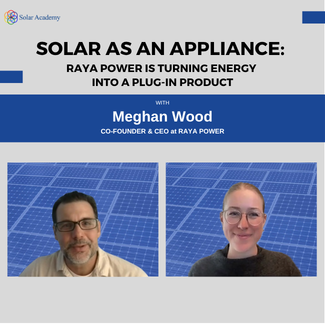
In this Solar Conversation, Kerim Baran sits down with Meghan Wood, CEO and co-founder of Raya Power, to explore a bold rethinking of residential solar: what if solar weren’t a construction project—but an appliance? Born out of deep frustration with the complexity, cost, and limited accessibility of rooftop solar, Raya Power is building plug-and-play solar + battery systems designed for everyday households, not just high-income homeowners.
From Stanford classrooms to Puerto Rico’s grid outages, Meghan and her co-founder Nicole Gonzalez, set out to redesign solar from first principles—focusing on affordability, simplicity, and resilience. The result is a backyard “solar pod” system that bypasses permitting, reduces customer acquisition costs, and delivers immediate bill savings while providing backup power. This conversation dives into the origin story, product design, regulatory constraints, and why distributed “micro-grids” may redefine how millions access energy.
Chapter summaries of this conversation are below:
[00:00] Introduction
Kerim introduces Raya Power and shares his personal connection as an investor. The conversation sets the stage around “solar as an appliance” and the opportunity to reach underserved segments.
[01:30] Founder Origins & Stanford Connection
Meghan shares her journey from Bain consulting to renewable energy at Stanford, while introducing co-founder Nicole’s background at NASA and her motivation stemming from Hurricane Maria in Puerto Rico.
[03:30] Meeting of Minds & Early Ideation
A chance meeting at a wedding sparks a deep collaboration. The founders begin exploring why solar adoption is still limited and how to redesign it for broader access.
[05:00] Designing for Accessibility (Extreme Affordability)
Nicole’s design philosophy—building for underserved users first—shapes Raya’s product approach. Early customer discovery included fieldwork across California and Puerto Rico.
[06:30] The Core Problem: Why Solar Isn’t for Everyone
Barriers to adoption are unpacked: home ownership, upfront costs, roof requirements, credit constraints, and high customer acquisition costs (~$5K per customer).
[08:30] The Breakthrough: Solar as a Consumer Product
Raya’s thesis: eliminate custom installs, permitting, and complexity. Instead, create a standardized, movable, plug-and-play system that behaves like a household appliance.
[10:00] Balcony Solar vs. Raya’s Approach
Discussion of “balcony solar” trends in Europe vs. U.S. regulatory hurdles. Raya avoids backfeeding entirely by connecting directly to appliances, sidestepping key safety and code issues.
[13:30] How the Product Works (Pods, Batteries, Loads)
A deep dive into the backyard “pod” system: integrated solar panels, battery, and inverter connected directly to key household loads like AC units or fridges.
[16:30] System Economics & Real Household Impact
The system is sized to meaningfully reduce bills (~$80/month savings in California) while providing backup power. The goal: noticeable savings and resilience, not marginal gains.
[20:30] Target Markets: Puerto Rico, California & Beyond
Raya starts where electricity is expensive and unreliable. Puerto Rico leads due to outages and cost, followed by California and Hawaii, with broader U.S. demand emerging.
[23:00] Competitive Landscape: Batteries vs. Integrated Solar
Comparison with solutions like Jackery/EcoFlow. Raya differentiates by being always-on, aesthetically integrated, and financially self-paying through daily energy savings.
[26:30] Go-to-Market & Scaling Strategy
Early pilots in Puerto Rico and California show strong customer feedback. Initial distribution through installers, with a roadmap toward fully self-installable systems.
[30:00] Vision: Every Property as a Power Plant
Closing thoughts on distributed energy: a future where households generate, store, and manage their own electricity—turning energy into a consumer-controlled system.