


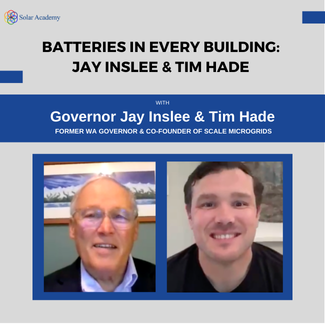
In this SolarAcademy Learning-In-The-Open session, Jon Bonanno is joined by Governor Jay Inslee and Tim Hade, co-founder of Scale Microgrids and CEO of Brightfield Infrastructure, for a deep dive into what it will take to put “a battery in every building” and build a truly distributed, equitable grid. Tim shares his vision for grid-connected microgrids and virtual power plants, while Governor Inslee explores how to align utility incentives, affordability, and climate goals, plus where fusion, nuclear, and demand-side efficiency fit into the clean energy toolkit we need to deploy at scale today.
Chapter summaries of this conversation are below:
- Learning in the Open & Fixing Information Asymmetry (00:00)
Jon welcomes Governor Jay Inslee and Tim Hade and explains the core thesis of Learning in the Open: people with money and access hoard insider knowledge, so this series is about openly sharing playbooks (finance, sales, tech) so low- and middle-income people can participate and succeed in the clean economy. - Tim’s Journey & “Battery in Every Building” (04:04)
Tim briefly shares his background: he founded Scale Microgrids ~10 years ago to build solar+storage microgrids for C&I customers, sold to EQT, and is now focused on his new mission at Brightfield Infrastructure—putting a battery in every building in the U.S. He jokes he “hijacked” the podcast just to tell Jay he’s a huge fan. - Inslee’s New Roles: Capital, Climate Power & Wildfire Relief (05:32)
Jay describes his post-governor work: advising Wallame Capital on clean infrastructure investments, serving as a national spokesperson for Climate Power to push clean-energy action, and helping build a fund for wildfire victims. He frames the clean-energy community as an exciting movement transforming culture, economy, and public safety. - Why Grid-Connected Microgrids Matter for Equity (07:29)
Jay asks whether Tim imagines stand-alone or grid-integrated microgrids. Tim argues everyone benefits from grid-interconnected systems: building-level DERs that transact with the grid allow the fastest ramp to meet new loads (AI, EVs, manufacturing) and prevent a “two-tier” energy system where only wealthy customers have reliable, clean power. - Tech Is Ready; Politics & Business Models Lag (08:10)
Tim says the technology for a transactive distributed grid—hardware, software, VPPs, aggregators—is already proven; the remaining blockers are political, communication, and business-model issues. That gives him hope: it’s no longer a physics problem, it’s about aligning incentives and rules. - Octopus Energy, the Affordability Crisis & U.S. Policy (09:30)
Using Octopus Energy as a case study, Tim explains how high UK power prices pushed innovation: by controlling demand-side loads (EVs, thermostats, home batteries), Octopus co-optimized supply and demand to deliver cheaper power, proving distributed models can be profitable and pro-customer. To replicate this in the U.S., he says the focus must be on utility interconnection reform and state-level regulation that forces utilities and DER providers to work together. - From Technical Concerns to Economic Conflict with Utilities (14:04)
Tim notes that, thanks to VPP deployments (Sunrun, Tesla, Voltus, CPower etc.) and DOE’s VPP Liftoff report, the technical doubts about aggregation and reliability have largely been answered. The real friction now is economic: DERs reduce the need for traditional grid capex, so ratepayers benefit but IOU shareholder value takes a hit, and legislatures must figure out how to realign those incentives. - Messaging in an “Affordability First” Era: The “Yes, And” Strategy (19:23)
Asked how to talk about climate when everyone is focused on rates, Jay urges climate founders to use a “yes, and” communication approach: always link affordability, reliability, health (asthma, air quality) and climate in the same narrative. The key is to show that solving for clean energy simultaneously lowers long-term costs, creates jobs, and protects health—“two problems with one stone.” - Pragmatic Climate Tools: Fusion Hope, Fission Economics & Betting on Batteries (24:05)
Jay calls for practical, non-ideological decisions: use any low- or zero-carbon tool that fits the job, given the risk of climate-driven societal collapse. He’s very bullish on fusion (highlighting Helion and other fusion startups racing to first commercial power) but skeptical of fission economics, noting recent reactors and SMR efforts can’t compete with ever-cheaper solar, wind, and batteries. Still, he wants fission R&D to continue as a “backup option” given the stakes. - Deploying the 90% We Already Have: Efficiency & Load Flexibility First (31:31)
Jay warns against letting excitement over new tech distract from deployment: “90% of what we need, we have today”—renewables, batteries, and especially efficiency and load flexibility, which he calls our “first energy source.” He and Jon reference DOE Liftoff guidance that demand-side measures are the lowest-cost, fastest path to unlock grid capacity for future loads, and close by reminding listeners that the needle has moved (EVs, cheaper batteries) and now the mission is to accelerate and scale that progress.
Jay Inslee
Jay Inslee is the former Governor of Washington State and a long-time national leader on climate and clean energy policy. He is a senior advisor to Wallame Capital, a national spokesperson for Climate Power, and an advocate for wildfire victims and climate resilience. Inslee co-authored Apollo’s Fire and helped inspire the Evergreen Action Plan, focusing on practical, sector-by-sector strategies to decarbonize while creating jobs and lowering costs.
Tim Hade
Tim Hade is the co-founder of Scale Microgrids and CEO of Brightfield Infrastructure. A veteran and clean-energy entrepreneur, he has spent a decade developing solar-plus-storage microgrids for commercial and industrial customers. His current mission is to “put a battery in every building in the United States,” with a strong focus on grid-connected microgrids, virtual power plants, and ensuring an equitable, affordable distributed-energy future.